


I don’t normally do politics content, but Bethany Andres-Beck’s team reached out to me. After a brief screening conversation, I thought it would be an interesting opportunity to talk about AI, regulation, and politics.
Bethany has worked as a software engineer at BAE Systems, TripAdvisor, Twitter, and more. They also served as the tech lead for building Hillary for America’s donation platform. Beth is a well-known figure in the Agile/Extreme Programming world and helped coin frameworks like Forest and Desert. While most politicians seem to have very little understanding of AI—or technology in general—Beth has been working in it for years and has a more considered stance than the knee-jerk anti-AI positions that have been a staple of recent campaigns.
This is not an endorsement, and I’d encourage readers who disagree with Beth’s politics (Democratic candidate, DSA member) to engage with the ideas more than the labels. Part of the reason I took the interview is to examine the nuances of policy more.
The piece also isn’t an endorsement of the policies. I do have my own opinions in a long-stalled draft, but I think the interview is a good opportunity to explore the question with someone who’s seeking public office and needs to both think about what to propose and balance AI’s public unpopularity.
Highlights
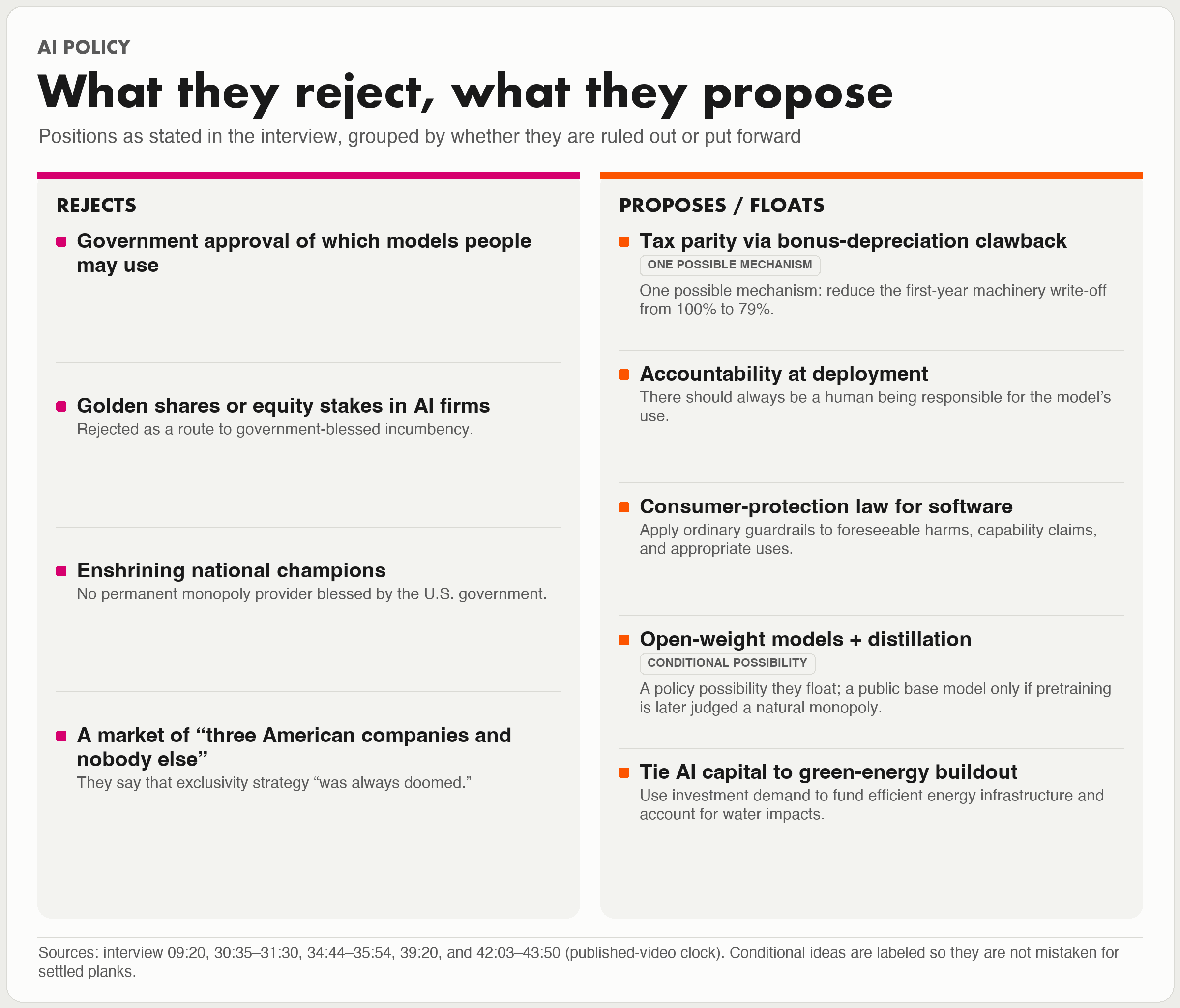
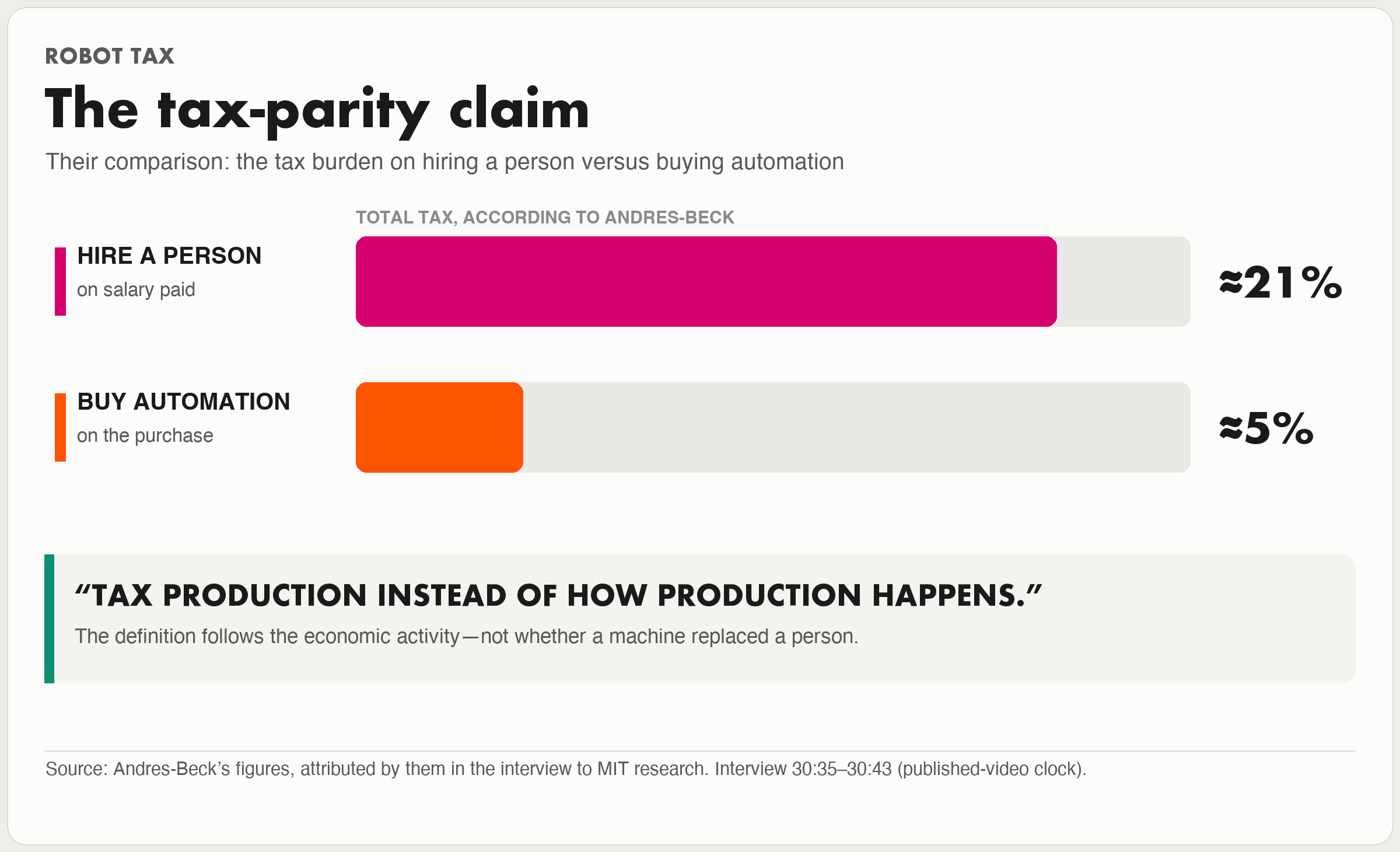
Robot Tax. The definition of “robot” matters less than the tax code substantially advantaging automation at a tax rate of ~5% vs. human workers at ~21%. [30:35]
Don’t let the government pick models. Beth is a DSA member but surprisingly doesn’t support the government dictating what models to use. Partly from Beth’s background in technology platforms and open source. [34:49]
Liability regimes are key to responsible technology use. Suggests consumer-protection law plus a named human responsible for every deployment. [35:55]
Disagrees with golden shares in OpenAI/Anthropic. Asked about Bernie’s plan, “a terrible idea… Amtrak is nobody’s favorite train company in the world.” [42:08]
If it’s possible, suggests a government foundational model that everyone distills from. Housed at something like the Library of Congress—explicitly conditional on general pretraining/post-training economically evolving into a natural monopoly. [43:38]
AI company monopolies are what we should be guarding against. The story looks similar to software. Once a monopoly without alternatives emerges, it can easily reprice 10x or more without fear of consequences. Brings up examples in software. [40:48]
It’s less left vs. right relative to urban vs. rural, given where data centers are being placed. “I think this is where the public movement comes in—the fact that you’ll have 2,000 people show up at a meeting against data centers. No one has ever, that I know of, had two thousand people show up at a meeting about self-driving cars anywhere, much less like every town in America, you can get that.” [47:27]
Transcript
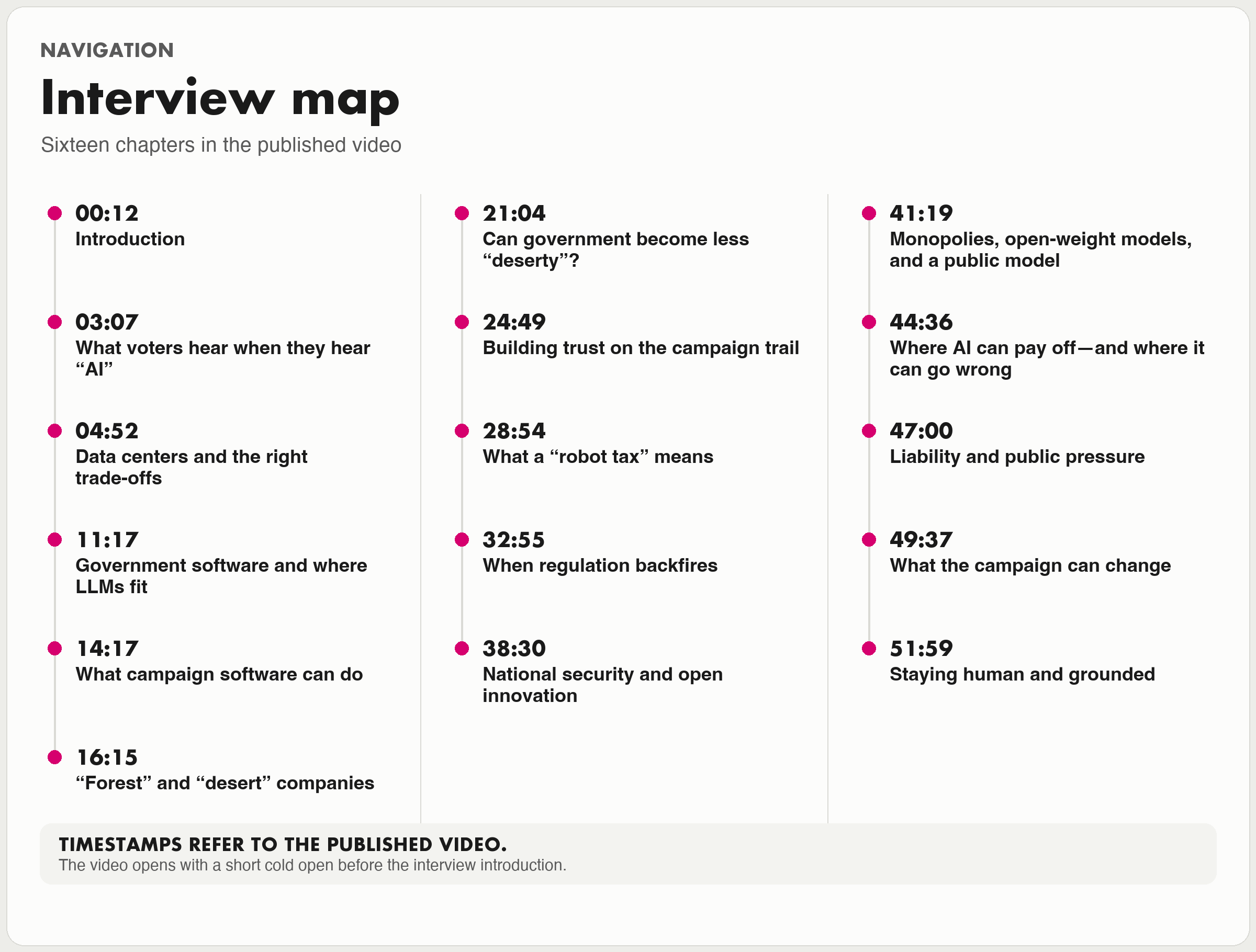
Lightly edited for readability. Timestamps relate to the published video.
Introduction
[00:12]
[00:12] JAMES: Hi, everyone. I am pleased today to be joined by Beth Andres-Beck, running for the House in Massachusetts’ 6th Congressional District. I think this is a particularly interesting conversation because I don’t normally cover politics, but Beth is a software engineer, knows tech, and isn’t just knee-jerk anti-AI. I thought it would be interesting to talk about what’s going on on the campaign trail, how Beth has been thinking about these particular topics, and get a sense of where things are in the political field. Beth, I’d love it if you would introduce yourself to the audience.
[00:47] BETH: Absolutely. My name is Bethany Andres-Beck. I’ve spent more than 20 years working in the field, from self-driving cars and computer vision work back in the aughts to TripAdvisor, Twitter, a startup called the Long-Term Stock Exchange where we did start a stock exchange, and, most recently, writing software for primary care doctors and patients. My hobby for a long time has been politics. When I saw that no one had stepped up to challenge my former Congress member Seth Moulton, I stepped up to challenge him. Then he stepped aside to run for Senate. Now it’s an open race, and I would be the first person to go directly from working as a software engineer into Congress.
[01:31] JAMES: Just kicking off there, why do you think that’s the case? It seems like Congress and a lot of our policy bodies don’t have much tech background or experience.
[01:41] BETH: Part of it’s just money. It’s a lot easier to get to Congress if you’re a lawyer than from any other field. If you’re rich, you’re ten times more likely than the average person to go to Congress. If you’re a lawyer, you’re a hundred times more likely than the average person to go to Congress. Once a lawyer is running, they’re twice as likely to win, and it’s because lawyers donate to each other’s political campaigns.
We just don’t have that history of political involvement in tech. I call up people I’d worked with before, and almost none of them had ever donated to a political candidate. That’s a very different place from which to enter the world of politics. What we see instead are people who have become executives, so they have their own money they can spend on it, people who went into marketing, or people who went off and got a law degree. Those are the ways people with technical experience most often move into politics. But it hasn’t been something, at least in my career, that people really talked about or thought about: what would it take to get programmers involved in making decisions about technology?
[02:45] JAMES: Good to know why all the problems in our country are the way they are: too many Harvard- and Yale-educated lawyers. Even though tech folks aren’t well represented in politics, technology has become a hot-button issue. What have you been hearing on the campaign trail? How do you think about that?
What voters hear when they hear “AI”
[03:07]
[03:07] BETH: I see a huge gap between the way average voters are thinking about technology and the way political people are thinking about technology. I think it’s because the people in political spheres are mostly talking to executives, salespeople, lobbyists, and consultants whom tech companies have hired out of political circles because of those connections. It means they’re getting a very skewed view of the world. As a result, we have billions of dollars in subsidies going to data centers and AI, and voters feel like their concerns don’t even feature.
No one is talking about how, when you call your doctor’s office, you’re now stuck talking to a robot, you can’t figure out how to get through to a real person, and the robot can’t help you. That’s one of the very common experiences I’ve encountered that people have had as their first—or maybe even only—experience with AI. Rolling out those products that only sort of work sometimes, in some places, has been really bad for our public image. It means that when a data center comes to town and people present it as an exciting opportunity to get involved in AI, what people hear is, “we’re going to have a warehouse where we store the robots I hate talking to.”
[04:25] JAMES: Especially since you’re running in the Democratic field, it would be easier to be knee-jerk anti-AI—to say, “We hate this stuff. It’s completely useless.” From your perspective, why have you been interested in not being completely anti-data center or completely anti-AI? Why do you bring this particular viewpoint to the table?
Data centers and the right trade-offs
[04:52]
[04:52] BETH: It may be naive, but I still think that we should be accurate and correct and be trying to get to the best possible outcome. I’ve worked in data centers. My work has taken me into data centers. I’ve never worked there on a day-to-day basis, but I know how few jobs they create because I’ve been in them, and I have computers in them. I know that you don’t want a bunch of people getting access to those machines.
I also know there’s a huge difference between the data centers we’ve used for decades and a hundred acres with a bunch of natural gas generators hooked directly up to a natural gas pipeline. That’s a scale of construction that certainly we had not been looking at. I think, if we were to take a step back and consider: does this just mean that these technologies are not ready for prime time? Are we trying to brute force things rather than get to efficiencies?
When I started out, computers were a lot physically larger than they are now. We could do a lot less in the same amount of space. That’s going to be true ten years from now, and it’s going to be true twenty years from now. The trade-off to society of space and energy—especially in a time when we’re finally getting green energy that is cheaper than traditional forms—and whether this is the right decision for all of us is a different question than whether it is the right decision for OpenAI or X.
That’s the role government should be playing: stepping back from just considering economics and looking at what we’re trying to achieve and how much of this is doing that.
[06:34] JAMES: How do you balance those things? You still believe technology has a role and can help, but there are questions about data centers and their trade-offs. How do we balance them, especially as these facilities are built out?
[06:51] BETH: One thing is that right now we are heavily subsidizing things. I am a socialist, but looking at the capitalist side, if you subsidize something, you’re going to get more of it than we would naturally produce. You do that if you think there’s some reason we’re not producing enough of it. Sure. But if there are negative externalities—if this is going to have negative impacts on the community around it—it would make sense, if we want to get the right number of these, for that to be part of the cost you pay for a data center.
I think a lot about how we get the incentives right. How do we set up a system where we don’t have to decide at the top how many data centers we should have, but we also aren’t putting our thumb on the scales and saying we are going to turn 20 percent of farmland into data centers because we want more data centers? We should have something where the costs are borne by the same people who are getting the benefits, and the value coming out is widely shared and not a monopoly. Those are the things I’m most concerned about.
Right now, an AI company sells a tool. Someone puts a wrapper around it and finds a really good use case, but is an LLM the right answer for whatever that application is? We’re seeing this in law, where it is not really a great tool if what you’re looking for is reliable citations. There are other approaches to machine learning and AI that could be better in those cases. We don’t have those yet, but when the company making the tool doesn’t bear the cost of those mistakes, it might be perfectly happy selling a tool that only works sixty percent of the time.
[08:38] JAMES: One question is the data center incentive model—whether it’s tax credits or other things, or whether the company itself bears the cost of the new interconnects and new power generation. The second is whether LLMs are the right tools for everything. I agree that they aren’t, but they seem to have a place. I’m curious whether some of that place belongs in government as well, because I think one of your particular planks is that government could use better software, use more technology, and come into the modern era a little bit.
[09:19] BETH: Let’s start with data centers. I want regulation that puts the companies building data centers well on equal footing with people cutting as many corners as they are legally allowed to. We know that we need to build out massive green energy infrastructure in this country just to move to energy independence and mitigate the impact of climate change. We have a lot of investors right now who would like a piece of AI companies and investment in AI. If we can tie those two things together, we can use that capital investment to fund the energy infrastructure we need anyway.
We’ve seen tech companies purposefully put their compute in some place like Finland that has built more efficient data centers because they care what the carbon impact of their computing is. If you put it in a country that has had incentives to build these things well, it also gives companies the option to do that. I would like to see us have that model: you’re building out the energy; it supports good things with the water usage; and it is as efficient as possible, rather than going up as fast as possible.
The other thing about the incentives and subsidies right now is that we’re building data centers wherever people think they can get away with building them. Very often, that’s smaller towns they can threaten to sue, or states that offer communities less opportunity to push back. Those aren’t necessarily the landscapes best suited to data centers. I’d like to make sure we build them in places where we have the infrastructure and where it makes sense—where that is the most efficient use for the land—rather than just where democracy is weak.
Government software and where LLMs fit
[11:17]
[11:17] JAMES: Is there a role for AI—and, more specifically, LLMs—in government? Could you also expand on your thoughts about government incorporating more software and technology?
[11:32] BETH: One of the things we’ve seen is that our government has built most of its technology in these giant contracts with contractors. You have to define all the requirements up front, get a bunch of bids, one person bids, they go build it, and if it doesn’t work, you have to pay more. We know that waterfall development doesn’t work at the best of times. When we are doing waterfall development and taking the lowest bids, it’s proven even harder. It’s especially hard to maintain software over time. You end up with twenty-five-year-old systems that have never been integrated as other systems have come online because that would be a new contract.
Prior to the current administration, we saw some alternative approaches, and that’s what got turned into DOGE: the group that was going around and making sure that if someone in the government needed a website, they could get a website. It was far cheaper and far more responsive than trying to bid things out to contractors so shareholders could get some part of the profit. I’d love to see more software development like that, where we decide what we want the software to do, and then the government is able to efficiently and effectively build that software.
The places where I’ve seen LLMs have really big payoffs are cases where you’re looking for a counterexample. A lot of the math results that are coming out, and things that are that sort of search space, are trying to find something semantically similar. I think it’s a very strong semantic tool. There’s also a lot of software development that is semantic work. I’d talked about that for a long time, trying to get people to focus on the semantics over just the syntax. I think we’ve seen the power of that semantic tooling in the way LLMs have accelerated some forms of software development and made them accessible to a much larger group of people.
One of the things I expect to see is a bunch of startups built by people who have no background in building software but, with an AI, were able to stand up a prototype and prove that it’s useful. I haven’t seen LLMs able to build maintainable code yet. Whatever the next level is that’s going to get us to having it consider architecture, we have not invented it yet. But it’s good enough to prove out ideas, to prove value, and to let us build software that just wouldn’t have been built otherwise.
[14:00] JAMES: You also worked on a campaign, helping to build some of its infrastructure. What did you see technology do in that case?
What campaign software can do
[14:17]
[14:17] BETH: One of the interesting things is that technology teams aren’t part of most campaigns, so it’s not very common for tech to be part of campaigning. Most of the time, people rely on third-party or outside software products that they pay for, and they have to cope with whatever they’re getting. It was a real luxury on a presidential campaign to be able to build a team. Ultimately, by the end, we got to seventy people. They did everything from supporting data analytics and machine-learning approaches to voter engagement—identifying voters we might want to engage—to writing the donation website, which was my job.
We made that website run on IE7 and had a fallback in case everything was offline except for DNS. As long as DNS stayed up, we could serve you a donation website, get something back, and process it later.
I haven’t often in my career had the kind of high reward for very specific optimization, but we were able to raise more than $20 million extra for the campaign just by making that website behave really well.
Campaign people aren’t necessarily used to collaborating with software development people, but it’s a place where agile methodologies really shine. Sometimes, if we can get this done by next Tuesday, it’s worth doing; if we can’t, it’s not. Building incremental pieces and having something launched by Friday that you can improve until Tuesday guarantees you’ll have something. It’s worth putting the time into that, and we did a lot of it. The challenge is always: how do you pay for it? Campaigns are trying to save every dime they can find, everywhere they can find it, and software is expensive to build well.
“Forest” and “desert” companies
[16:15]
[16:15] JAMES: You and, I think, your father are both figures within extreme programming and agile programming—the entire process, CI/CD, and other things. Can you describe the philosophy you have put together and that particular framework?
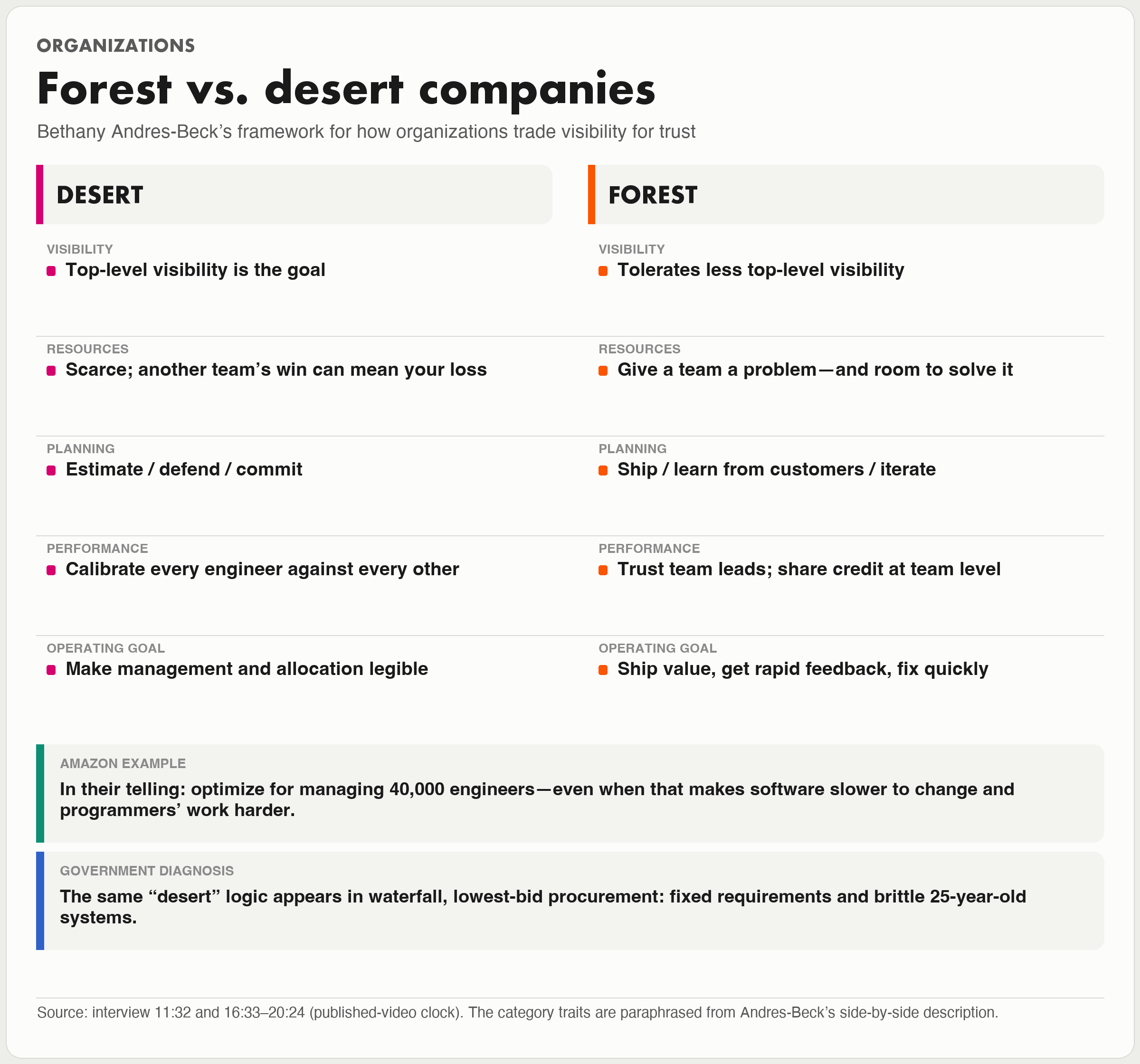
[16:33] BETH: This came out of my experience at very small and very large companies. My father’s Kent Beck. He invented extreme programming, a style of working together for a group of programmers and a customer. It ignored the existence of executives and management chains: that’s irrelevant; just let us build useful things. We’ll be good. It turns out that ran into problems in corporate environments. It works very well in some companies. In others, teams might be delivering and still get shut down: this doesn’t fit with how we run the company.
When my company was bought up by Amazon, I realized the hard part for Amazon is not building software. They don’t really mind if their software isn’t super flexible. If it takes six months to change, all of that’s fine. But they’re trying to manage forty thousand engineers at a time, and to them, the much harder problem is how do we manage these engineers? How do we have visibility through the entire company? And so they didn’t mind if they made programmers’ lives harder, if it made managers’ lives easier. And so that is what I describe as a forest or as a desert company. You can see all the way to the horizon, but resources are scarce. People feel like if some other team is doing well, it means that they’re going to get less. You have a lot of time spent trying to estimate, and then a lot of pushback on whatever estimates the engineers come up with until they are willing to lie about how long something’s going to take, and then a lot of pressure on them when they don’t deliver it in the timeline that you made them commit to. All of those things would make no sense if your goal was just how much value can we deliver to customers. But they make a lot of sense if the hard thing is how do we decide what to have our engineers work on, and how do we decide who gets to have engineers at all?
And then on the flip side, in companies that are willing to tolerate less visibility, that are willing to tolerate not knowing what every engineer is working on this week, you can let a team, you can give a team a problem and let them go do a sprint, and six weeks later come back. You know they’re working with a customer, so you know they’re getting real feedback on whether this is working. And you may not know who on that team is responsible for any given task. If some great feature comes out, the entire team shares credit. You kind of have to trust individual team leads or managers to know who on their team is performing well, who needs support, deal with the performance problems because you aren’t going to see them up at the top. And you can’t have one process that calibrates every engineer against every other engineer because you’re not working in the same context as every other engineer. Someone who’s working on a feature that has zero users, you don’t have to care how reliable that feature is yet. Whereas someone who’s working on a feature that is doing, I don’t know, 100 million dollars a month, they really have to care that they aren’t breaking things. And so those two teams might be operating in very different styles.
And management trust: if you build a high trust environment, do all the things the book Accelerate talks about—high accountability, rapid feedback cycles, the ability to ship constantly, the ability to fix problems quickly—you can build really reliable software that works really well. But it takes a level of trust that you aren’t going to have if the hard part of your company is managing forty thousand people.
I think we definitely see this in government. Part of what the U.S. military did differently from other militaries was ideas like commander’s intent: when you got orders, they said why someone had given them. Your job was not to do exactly as you were told, no matter what. It was to do what you were told as long as it served that purpose.
[20:24] JAMES: I’m glad you also brought up the military example, especially since we can dive a little bit more into national security a bit. But I do think that forest and desert analogy is a great analogy in terms of where do we also see extreme effort put into documentation, stakeholder management, transparency to executives. The bigger thing being get buy-in to do a giant monolithic thing and not basically have it frozen in time forever. Sounds like a really good description of government, especially the legislative process. How do you think about that in terms of changing the culture of government or trying to move towards something that isn’t so desert?
Can government become less “deserty”?
[21:04]
[21:04] BETH: It’s a great question, and I haven’t been there yet to experiment. But things that I’ve seen work inside of those large desert companies is identifying why something is the way it is, and then finding a way to over deliver those parts. So, if someone is worried about you having visibility into what everyone’s working on, oftentimes I would do the daily standups we’re going to do anyway, and I’ll take notes and I’ll update all the tickets. And if you have one person who does all the busy work and provides cover for everyone else, they can work in effective ways. They can build the relationships so they all understand the software, focus on that, but we can still satisfy whatever the systems are that need to be satisfied.
So that’s one piece. I think the other one—and this is something that software engineering does well in general—is taking really big projects and slicing them up into smaller, achievable steps, each of which gets us closer to the ultimate goal. It’s not something we see a lot in government. Very often, we’ll pass one bill, and then it’ll be twenty years before we do anything else on the topic.
When it takes that long to pass a bill, if you aren’t releasing often enough, you have to do really big releases. You’re more likely to break things, and it’s harder to get them out the door. All those things are true. I’m curious if there are paths forward that are about making lawmaking more efficient, accessible, transparent, safe, feeling safer, and more collaborative.
I think it’s a place where AI is particularly suited because it isn’t a left-versus-right, Democrat-versus-Republican issue. Right now, it seems a lot more rural versus urban because rural areas tend to be where they’re putting data centers, and people are mad about it. But I expect that eventually one side will probably decide to jump on the bandwagon, and the other side won’t. Right now, I can talk to random Republicans on the street, and they will have exactly the same concerns the random Democrats do. I think this is a great place to look at that and also to apply modern technologies. We don’t have our federal tax code in version control.
I spent four hours tracing back a piece of Massachusetts law to which vote in the legislature caused this to happen. That’s a question I could answer about any code I’ve worked on in the last twenty years, or any document I’ve worked on in the last ten years: where did this line come from? We just don’t have those kinds of approaches to information in Congress because we haven’t had the kind of technical collaboration and work on our own tools that would have gotten us there. If none of the people doing the thing can make the tools happen, you end up not having them. There’s a reason that software development has better tooling on computers than most other professions. It’s because we can build our own.
[24:03] JAMES: One reason I thought this would be an interesting interview is that you have experience in software and technology. You’ve also talked with a lot of folks on the ground. Your specific campaign, I think, identifies with the DSA group, and you have experience working with DARPA. Those intersecting areas make it less likely that you’ll boil the nuance down to a random talking point and slap it onto something. How do you talk to people about this? What you’re describing sounds great, but within your framework, the forest requires trust—and trust seems very lacking right now. How are you trying to bridge some of that gap?
Building trust on the campaign trail
[24:49]
[24:49] BETH: Yeah, some of it is just presenting myself as I am. The way I’ve always thought about this campaign is: if I have to change myself into something else, I wasn’t likely to succeed anyway. I’ve grown up on the internet, and there’s 30 years of me writing and doing stuff out there. Someone’s gonna figure it out. So let me put myself out there.
The way I introduce myself is: I’m a software engineer, and I want to make sure AI works for all of us. Most people have no further questions. They will start telling me about their experiences with AI and why they’re worried and what they’re worried about, because they know that they’re worried. They weren’t sure anyone else was. They’re especially worried that it doesn’t feel like anyone in a position of power is looking out for them, understands what they’re worried about, or even knows that these things are affecting their day-to-day lives.
By echoing back to them that this is important and it matters, we’re already building trust. Not everybody is going to trust me immediately. But I think that simply behaving in trustworthy ways gets you surprisingly far because so few people are doing it. That’s not the usual strategy, because most people running for office are very good at fundraising, and that’s the skill set they have.
What I’ve spent the last ten years doing is getting groups of people to trust each other enough to work together on software. When people challenge me, it’s very often: what are you going to do about it? There’s an immediate fear that there is no solution. The next thing I say is: I believe we need laws that protect people, the environment, and our future. Very often, that is all they were looking for. Have you thought about it? Can you present to me a plan that seems to make sense?
If I started there by talking about my actual plans—shifting the tax burden from work, from payroll taxes to automation taxes, so that we can continue funding Social Security and Medicare—their eyes would glaze over. That’s not the problem they’re seeing. The problem they’re seeing is they can’t call their doctor. If I’m not talking about the problem they’re seeing, they don’t have any way to evaluate whether the idea I’m putting forward is a good idea. That’s not the level of abstraction we’re going to have a conversation at.
I think that’s a place where technical people can very easily get lost: we’re excited about the details. We want to share all of these cool things we know. For someone who doesn’t have the one step back from that, it feels overwhelming. It feels like they have to do a whole bunch of extra homework before they’re ever going to be able to work with us and support our political goals. That doesn’t feel good. It makes them feel like we don’t know anything about their lives.
Being able to have a conversation that acknowledges the problems they’re having and tells them they’re not wrong, right? You are correct. And I have a solution. Well, thank goodness, right? Do I care about the details of the solution? No. Please hit the button that says this will work better. We’ll get into all of those details when we’re actually making law. That’s the right time, because I’m not going to be able to just pass whatever I want. It’s going to be about building a coalition of people who want to see these improvements happen.
Very often in software, there are five or six reasonable ways to do something. Which one we choose depends on some things, but sometimes we just flip a coin, right? Or one person was really excited about this, and the other one said, “Well, as long as it can handle X, Y, Z cases, I guess that’s fine.” We tried it out, and it could handle those cases, so we’re good. We’ll go for it.
And that would be my approach to legislation is: there’s not the one specific law I already know that I’m going to absolutely pass word for word. It is: I know what I want legislation to accomplish. I know what we need these laws to do, and I have at least one proof of concept for each of them, so that I know it’s possible.
What a “robot tax” means
[28:54]
[28:54] JAMES: That’s a good segue for jumping into the details, which I think this audience would appreciate. One of the more specific proposals is a robot tax, and I’d love to know how to think about that, because it almost begs the question. I’ve heard both things from a lot of Democratic candidates and, I think, in some of your Blue Sky posts and whatnot: AI is a big bubble, and it’s hard to say if it will do anything; at the same time, it’s going to take everyone’s jobs.
On the robot side, what makes this different from, say, CI/CD pipelines? To some degree, you’re taking away some QA engineers’ and infrastructure engineers’ jobs, maybe, or at least changing the nature of the jobs. Should we have taxed that too? Getting down to brass tacks, what is this thing? What makes it different? Is it not different? How should we treat it?
[29:51] BETH: So I call it a robot tax because that’s an idea that’s been out there since the ’90s that Bill Gates originally proposed. I’m not really interested in the definition of a robot or if it’s replacing a human. AIs might be great at jobs that no human has ever done.
Same time, I do think that there are ways for AI to take jobs, even if it isn’t productive, which is when companies are spending their money building data centers and not on other forms of innovation. I think a lot of the layoffs we’re seeing aren’t because people have been replaced by AI. It’s because whole business lines have been replaced with spending on AI instead.
The thing that I would like to see is that right now, if you hire a person, you end up paying on average 21 percent in taxes on whatever salary you pay them. If you buy a piece of automation, you are paying about 5 percent tax on that over what you just paid for it, and that’s it. It used to be higher, but through a bunch of obscure tax rules, we’ve cut that down and down and down. Now it’s much cheaper to hire a machine than an equally productive person that costs the same amount. That seems backwards. We shouldn’t be discouraging people from employing humans. There’s always going to be some downside to humans—we get the flu.
When I propose a robot tax, rather than trying to describe exactly what a robot is, what I want to see is that we are taxing automation just as much as we are taxing people. We are taxing production instead of how production happens.
[31:24] JAMES: But maybe describe a little bit more by what you mean about taxing automation less than people.
[31:30] BETH: There are several different mechanisms we could use. One is that because we’ve moved all bonus depreciation to year one, people are writing off 100 percent of the cost of machinery in the first year. We could just take payroll taxes off the top of that, so you get to write off 79 percent of the cost, not 100 percent.
But that’s just one possible implementation of many, and there is the question of which things are productive—like depreciable assets. There’s some very good research out of MIT; that’s where the numbers about how much we’re currently charging people come from. They are more skeptical than I am of taxing automation. I think we’ve seen with payroll taxes that people still get hired. I don’t think the demand for automation is that elastic, except where people are a close substitute—where you’re choosing between a person and a computer. But I think, in general, it’s going to be pretty inelastic. The same way investment is pretty inelastic, and those.
So I look forward to hearing what ideas are most palatable to other members of Congress. But I think it’s important that we’re not rewarding companies that fire people. Just to have society continue.
When regulation backfires
[32:55]
[32:55] JAMES: Sure, I have my personal skepticism that they’re actually firing people to reallocate just to AI. I have a suspicion that many of these companies are laying people off because they overhired, and it’s great to attribute it to AI because you didn’t make a mistake. You’re taking advantage of a new shining opportunity that Wall Street should expect will produce much more profit later because it’s AI or something.
A lot of these things are difficult to implement, though. It’s easy, especially from a desert perspective, to mess something up in ways that are hard to preconceive because you can’t see around every corner. With the political dysfunction these days, it seems even harder—more deserty. We’ve seen instances of this before the current dysfunction: Prop 13 in California and state government; FOSTA-SESTA in 2018, which was supposed to do good things for vulnerable populations and instead does the exact opposite. And then we look at—
[34:03] BETH: To be fair, we knew that was going to do the exact opposite when it passed. True, that’s true. I hate being right—it really sucks being right.
[34:10] JAMES: Now we’ve definitely seen that it did not do the right things. For Europe, lots of their regulations have the best intentions, yet somehow they find ways of doing the exact opposite in ways that I can’t even imagine how you would do that deliberately. It’s just hard to do regulation, and especially with the political dysfunction that we have. How would you think about government being able to step in that way? It’s hard for me to trust that government is going to get it right. And if government gets it wrong, I might argue that could be worse than just not having government step in at all.
[34:44] BETH: It’s part of why this is a place where I do lean on market mechanisms. I don’t want the government trying to tell me which model is okay for me to use because that’s not something the government is good at. But we have this thing, these consumer protection laws, and I can trust that my microwave’s not going to explode because we have consumer protection laws. When X-rays first came out, they were using them to X-ray kids’ feet to see how the shoes fit, right? We don’t do that anymore because we have consumer protection laws.
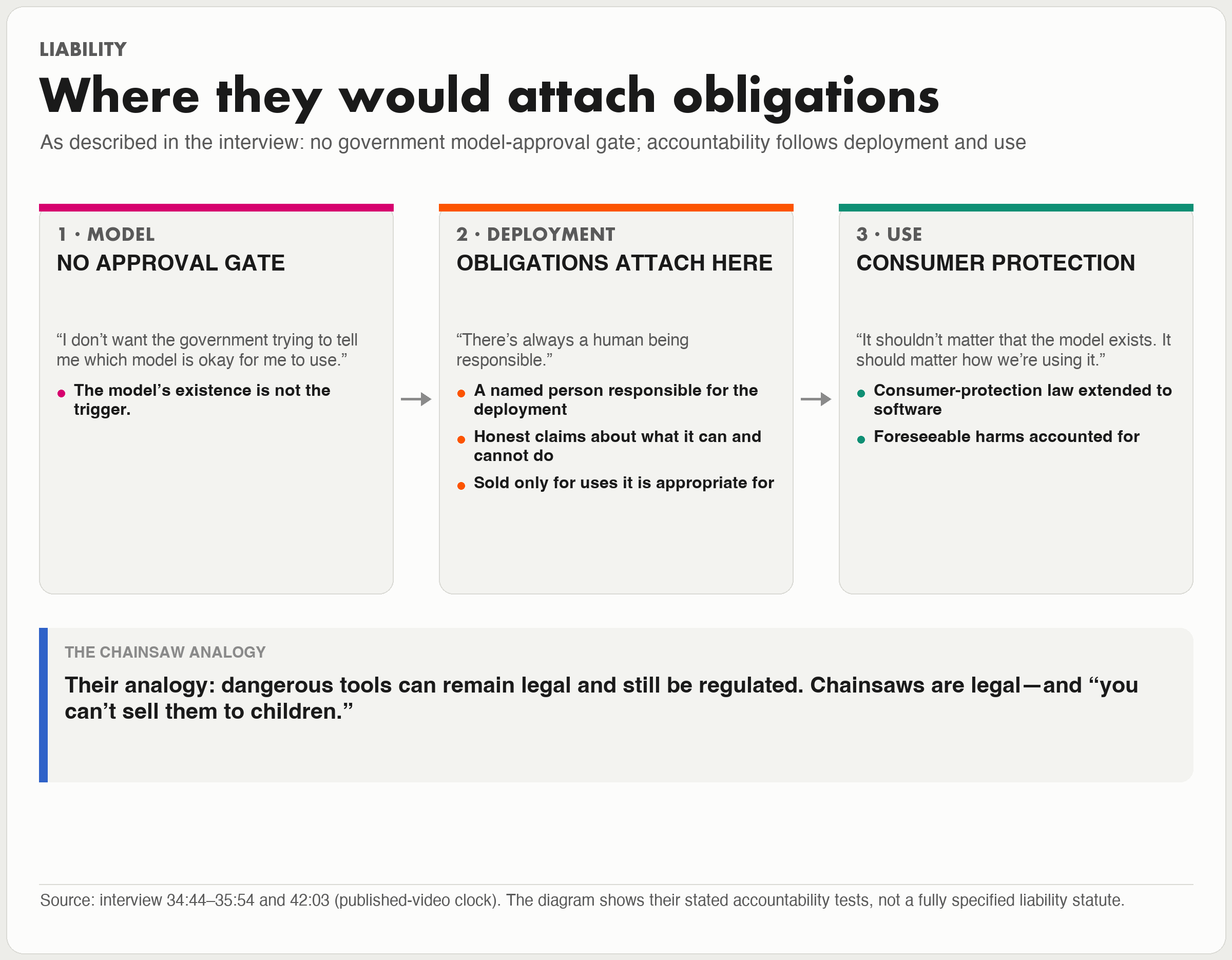
I would like to see those laws applied to software, and we’ve gotten away with not having them apply to us for 50-plus years. But I think these AI products have enough foreseeable harm. It’s not, “No, we had no idea this could do that.” We know the kinds of errors that tend to come out of models like this. We know that we can’t block every possible path someone could use to get them to hack something because we—it’s natural language, right? There are severe limitations to some of those things, so we should treat them as the dangerous tools they are. But we have a lot of dangerous tools. I’m way more afraid of a chainsaw than I am of an LLM. But we also have laws about how chainsaws have to—like, you can’t sell them to children, right?
I think, in times when uncertainty is high—and this is certainly one of those times—falling back on things that try to grab control is very unlikely to succeed.
I describe it as I’m an open source is good nerd, not a the government should run the internet nerd. I like distributed systems where people can make decisions that are good for them, but that requires them having information and not being lied to. Plenty of people in our industry don’t understand attention transformations. These aren’t things that we are going to teach to everybody. If they have to understand all these models to use them well, we’re not going to be able to use them well. Those are very predictable outcomes.
At the same time, we can see the places where it’s broken stuff that already existed. For example, traffic to anything is now more than fifty percent bots. Some of that’s because there are more bots, but some is because there’s a lot less traffic. The result is that a bunch of these websites that produced useful information are going to go under. We are not going to have new information coming onto the internet as frequently as we used to, because you can’t make money off it anymore. The same thing is true of journalism. I expect to see similar things with open source software. We’re seeing a lot of open source projects having to ban AI-generated contributions because the quality bar for something that is in the infrastructure of every Fortune 500 company is just not the same as the quality bar for your personal website.
And so I think we could use the proceeds from taxing automation to support the things that automation has been undercutting, and make sure that we can bridge to a world where the things that contribute value get rewarded. For example, a public Corporation for Public Journalism that could support nonprofit newspapers across America, I think, would be a very productive thing to have. It would support towns like mine that lost our newspapers to private equity, and it means that if people are relying on LLMs for journalism content or to ask what happened yesterday, that there’s a place for the LLMs to look and find out.
National security and open innovation
[38:30]
[38:30] JAMES: Let’s assume we want to regulate these things, tax them, and support them. We aren’t in the same environment that we were in the 1950s, 60s, 70s, or 80s. The U.S. is no longer the sole player at the vanguard of technology. We have a global environment where there are national security questions and places our laws don’t reach. All these regulations run into a world where the U.S. can’t just make rules for everyone. How do we balance these things with that environment? How do we balance the national security concerns when there are other countries that could run forward with AI, everyone could use Chinese models, and we could no longer regulate them?
[39:20] BETH: Well, if our plan was to have it be three American companies and nobody else can do this, we were always doomed. There are so few times that has worked, and the times it has worked involve us killing like tens of thousands of people in order to make it work. I think that computer programmers—Linux, for example—were rebelling against this very thing, when operating systems were monopolies that were controlled and had national security implications, mostly for other countries rather than the United States. But there are serious national security implications of using U.S. software for other countries. A lot of Americans have contributed to Linux. I think it would be a mistake to take America out of the open innovation world and have us live in a world where just a few companies dominate things and have the power to raise prices.
One of the things I’m scared about down the line, from personal experience, is that they roll out AI and get small businesses to all fire their part-time accountants. All the CPAs go out of business and have to go get other jobs, and then the AI companies hike the price. I once had to switch from one maps provider to another in a month because the provider we’d been using came back and told us they were going to charge us a hundred times what they’d been charging on the contract renewal.
Luckily, if you have a nice little wrapper around your map class, that’s not too hard. But if you didn’t have that, you were going to be stuck paying a hundred times what you’d been paying for the next year. I don’t want that monopoly power to hit every company in America. I think that could be really bad for our economy, and we end up with a huge amount of our profits going to a couple of AI companies and their investors.
Monopolies, open-weight models, and a public model
[41:19]
[41:19] JAMES: That’s the interesting part about having lived experience in technology: usually, the industry breaks these things up when another technology is adopted and weakens the previous one. Bernie had a plan to potentially take some sort of golden shares in AI companies. My reaction—whether to golden shares or certain safety controls that Anthropic and OpenAI propose—is: please, no. I don’t want to enshrine these companies as the forever monopoly provider blessed by the U.S. government. What’s your perspective on enshrining these companies?
[42:03] BETH: I think it’s a terrible idea. I think we’ve seen that that’s a terrible idea. We’ve tried that. Amtrak is nobody’s favorite train company in the world, right? And that’s a more natural monopoly than this is. This is not a natural monopoly, and the natural cost of software is zero. Right now, it costs more than that to run these models. They’re still very heavyweight. But I think as we get more specific models, that’s also going to change.
I want to see a world where we can cope with the downsides. We can hold people responsible for what models they use, so that there’s always a human being responsible. I think that’s the piece that’s missing right now: who is responsible for deploying this model? It shouldn’t matter that the model exists, right? It should matter how we’re using it. If you’re building a model, are you honest about what it can and can’t do? Are you selling it for things that are appropriate uses for it? Did you design it to be addictive? We’ve seen with Facebook that you don’t have to do it on purpose. If you just fire everybody who doesn’t get their metrics to go up, evolutionarily you get a very addictive product.
And seeing those same incentives play out in AI worries me a lot more than even the national security implications because if we want to, we can do the same thing China is doing. We could have open-weight models of our own here that rely on distillation. That’s a thing we could choose to do. We could choose to have the government, if we decide it is a natural monopoly, to build that initial model, and everyone else is just going to distill off of that. That initial model would be the thing I would think would be an appropriate place for the government to do it. Why are we doing three of those when we could do one and have everyone distill from it?
[43:41] JAMES: And it relies on all of the collective.
[43:45] BETH: Writings of humanity that they’ve scraped off the web, so it would make sense that that would be something like the Library of Congress would do. They would provide a model based on all of the knowledge we’ve ever done in a way that has the value of that going back to people who are writing things today, so that we can have more of that in the future.
That kind of thing, you could imagine a stable system like that, but that’s not what we’re going to get to if it’s about making back money for investors. If that’s the goal, we’re going to get a very different system, one that is going to be constantly undercut from overseas in countries where that’s not the goal, where the goal is value. And that’s the downside of deserts: they can get beaten out by a much smaller, cheaper startup that is only delivering that their only concern is how good the software is.
Where AI can pay off—and where it can go wrong
[44:36]
[44:36] JAMES: Thinking about how AI can work for all of us and the right place for it, I’ll give you a moment to pontificate. Expanding on what you think about that—
[44:47] BETH: I think about the things that are too expensive right now to do. The places we are seeing LLMs in particular be particularly valuable are places where being wrong is fine. There’s not a big downside if you’re wrong, and the upside to being right is enormous, which makes sense for things like NP-complete problems. That’s what you’re looking for: those kinds of parallelization things where, if you could just hire six thousand people, you could have easily solved this. But it was never going to be worth hiring six thousand people. Those are the places where this is going to pay off a lot.
The more we can democratize access to that without building tools designed to, I don’t know, manipulate people into spending as much money as possible, the better. All the things that are bad when humans do them, we can also now do much more efficiently: fraud at scale, cults at scale, cheating at scale. Those aren’t things that we wanted more of. It kind of sucks that those are the first places this is taking off, because it was really expensive to hire someone to write all your papers for you. Only the really rich kids got to do that, and now everyone has access to it. Actually, nobody should have had access to that.
It turns out we’re going to find which things are good and we want more of those, and which things are bad and we want less. And how do we build a system where you don’t do that anymore? And that means we go back to writing all of our papers by hand on paper in a room with someone watching—that’s how it’s going to be. We don’t have elementary school kids smuggling calculators into their first-grade math classes, and I think we can get to that same place with AI.
But it’s definitely going to be a journey. It’s going to be a hard social transformation as things that used to be expensive are now cheap. And what I’m worried about is who does that give power to? And how are they going to abuse that power? So, I think the thing I am most worried about is private armies able to commit war crimes at scale with just one person deciding that they want to have that happen.
Liability and public pressure
[47:00]
[47:00] JAMES: The underlying issue for a lot of this is the liability model, right? We haven’t figured out the right model for social media companies. Even for something that should have been easier, like self-driving cars and whatnot, we haven’t figured it out. How do we establish a liability model for AI when we haven’t been able to deal with these things for decades?
[47:27] BETH: I think this is where the public movement comes in—the fact that you’ll have 2,000 people show up at a meeting against data centers. No one has ever, that I know of, had two thousand people show up at a meeting about self-driving cars anywhere, much less like every town in America, you can get that.
For better or worse—however broken our democracy is—we still have elections. Voters can still run things. All I had to do was a chunk of paperwork, then collect thousands of signatures, and I’m on the ballot. I’m a little ahead of my time, probably because there’s not a lot of media coverage of these things yet. It’s just starting to pick up, with people booing it at convention or convocation speeches and all of that, and people are noticing that there’s this popular sentiment.
But the popular sentiment is real, and if we can give it a direction that can actually fix the problem, we can get things done that otherwise would have been impossible. We’ve seen this over and over in America, where big changes have always happened because of public pressure. It’s not because politicians suddenly decided they were going to do the right thing and grew a conscience—their hearts grew six sizes that day, or whatever. It’s that people across the country realized railway monopolies were bankrupting their farms. You got socialists, farmers, and business people all organizing against railway monopolies, and then you got railway regulation.
And we haven’t seen that same kind of public pressure, even against social media, and especially not before AI came along, because people were getting real value from social media. That was where you saw your friends. And the fact that now your feed is full of AI, I think, is part of why people are starting to try to do more about social media, because AI has kind of broken the social contract that we’d negotiated. We’re like, yeah, we know you’re stealing all our data and selling it to absolutely anyone who asks. But I get to see my grandkids, so sure. If I don’t get to see my grandkids, why would I still do the rest of that?
What the campaign can change
[49:37]
[49:37] JAMES: What impact do you hope your campaign will have?
[49:42] BETH: There are two sides to that. One is in the 6th District. The last time we had an open seat like this was 30 years ago. This is the first time in 30 years we’ve had a chance to choose what kind of Democrat will represent us. We don’t have strong organizing across the district. I’m not endorsed by DSA because we’ve never endorsed a DSA candidate in this area, and we’re going to start with a federal office. Even though I’m a member, I encourage people involved in my campaign to join, and we’ll keep building that over time, we didn’t have that when we were starting out.
And then on the AI side, every conversation I have with someone where I tell them that I want to run for office because we can make AI work for all of us, and they believe me, is one more person who thinks that this is possible, who thinks it’s worth fighting for. And if I can get some of these specific ideas into the national conversations. There are people who absolutely do not want these things to happen. It’s going to cost people money. There’s a lot of people who don’t want the liability because they’ve gotten to see the last fifty years where we just got to play. We tried all sorts of things, and they don’t want to give that up. Even though we’ve now created something so powerful and useful and dangerous that we probably shouldn’t get to just do whatever we want with it anymore. But anything you can choose—even using less electricity—there are companies out there that would like us to use more electricity. They would like us to use as much electricity as we could possibly use because that’ll drive the price up, so they can make more money. Right? Like that’s how capitalism works. There’s always someone on the other side of the transaction, and so getting these ideas out there and getting the predictions out there, so that when these things start happening, people can look back and be like, “Yeah, that’s that thing Beth said was going to happen.” And here’s the solution we already know—a thing we can do something about. And so I’d love to avoid the 30 years of slow collapse and the Great Depression. I’d love if we could skip that this time. But if we can’t, we can speed up recovery, right? And I think we saw the difference between 2008 and the COVID recession, and the 2001 dot-com bubble burst, and what we do in response to changes really matters to ordinary people who are trying to put food on the table.
Staying human and grounded
[51:59]
[51:59] JAMES: What do you do to stay more human and ground yourself?
[52:03] BETH: When I’m not running for Congress, I sing in a choir, and I love singing in choirs even more than doing music myself because it’s such a visceral experience of building something bigger than ourselves. No one person in the choir could do all of that themselves. It is something that’s only possible because humans come together and make mouth noises. I think that’s an absolutely delightful celebration of what makes us human.
[52:30] JAMES: Awesome! Thanks so much, Beth. Thanks for joining me.
[52:33] BETH: Thank you so much for having me.
Thanks for reading (or listening!)
I hope you enjoyed this interview. If you’d like to learn more about AI’s past, present, and future in an easy-to-understand way, I’ve published a book titled What You Need to Know About AI.
You can order the book on Amazon, Barnes & Noble, Bookshop, or pick up a copy in-person at a local bookstore.

A useful and unusually grounded discussion. The point that matters most to me is that governance should focus less on the model itself and more on how capability is deployed, what authority it is given, and who remains accountable. As AI becomes agentic, that distinction becomes critical. The durable question is not simply what the model can do, but who authorized it to act, within what boundaries, and who can stop it.