


A politics podcast. A doctor and researcher’s interview transcript. A published article in a major newspaper. Mainstream media, and most people, used to be blissfully unaware of AI. In April, a mere three months ago, Megan McArdle, a columnist at the Washington Post, mentioned she used AI as a research assistant and for copyediting and the journalist/pseudo-journalist hivemind tried to cancel her.
Now? I’m hearing “According to ChatGPT” and “Claude says” everywhere.
Readers obviously know I’m not against using AI. My 30+ autonomous agents at this point illustrate that well. I’m not even against AI writing. I’ve fully documented how I use it before (end-to-end, with every draft) and feel quite confident in claiming authorship over my own work—in the same way that I still claim authorship over my book, which had zero AI help at all, but did have a large team of editors, copyeditors, and proofreaders.
I regularly use ChatGPT—which has a better image model—to help me generate infographics for my pieces. I use Claude, with adversarial review from ChatGPT and Qwen, to help me do research for some of my more data-heavy pieces.
Unless they’re the literal subject of the benchmarks (like in this piece), I don’t cite any of them.
Not only do I think it’s a bad idea, I think it’s actively corrosive to do so. And a great disservice to your readers.
Taking Responsibility
I probably don’t need to rehash hallucinations, especially in the context of factual searches. Yes, AI can hallucinate and spit out information that is totally wrong. But most people are pretty familiar with this phenomenon. We even have the now-popular term “AI slop” for poorly done work that’s just carelessly flopped out of an LLM.
Of course, that’s part of the cultural context that people who say, “Claude told me,” are counting on. If I just use the magic words, “well, ChatGPT told me this,” you know what that means. It washes my hands of responsibility in case it’s totally wrong. I mean, you know how AI is!
Well, yes, I know how AI is, but I’m still ok with using it. I’m also ok not fobbing off responsibility to ChatGPT or Claude. Why? I’m confident that when I use it, my output is correct. How? Well, because I check it myself. And I take responsibility if it’s wrong.
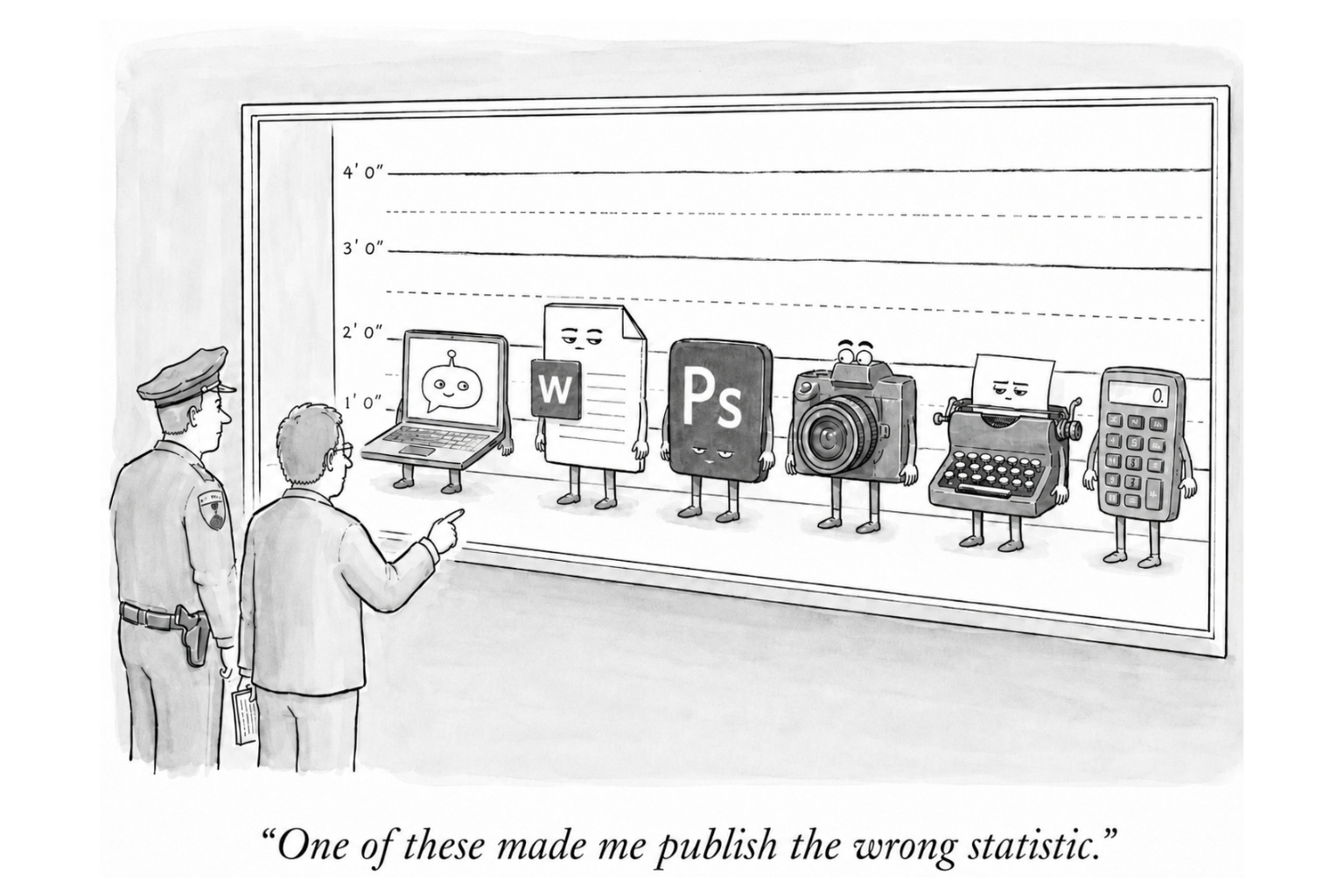
It’s like blaming Photoshop or Microsoft Word for putting out terrible work. It’s not my fault, Photoshop did it (with me using it)! That’s not my typo, it’s Microsoft Word’s fault!
That’s not only asinine, it’s frankly disrespectful to readers. The entire point of following someone credible is to be able to put real stock in what they’re saying. The writer did the work. That’s what the whole system of citing people is based on. You lend credibility by saying something and you should be putting your reputation on the line. That’s why I should trust what you’re saying.
I can see no other reason for throwing in that ChatGPT or Claude or Grok was your source… unless you’re looking to dodge responsibility in case it’s wrong.
Are there exceptions?
Sure. I already mentioned when AI usage is part of the methodology itself, like in my piece on knowledge agents or Simon Willison’s now-famous pelican benchmark.
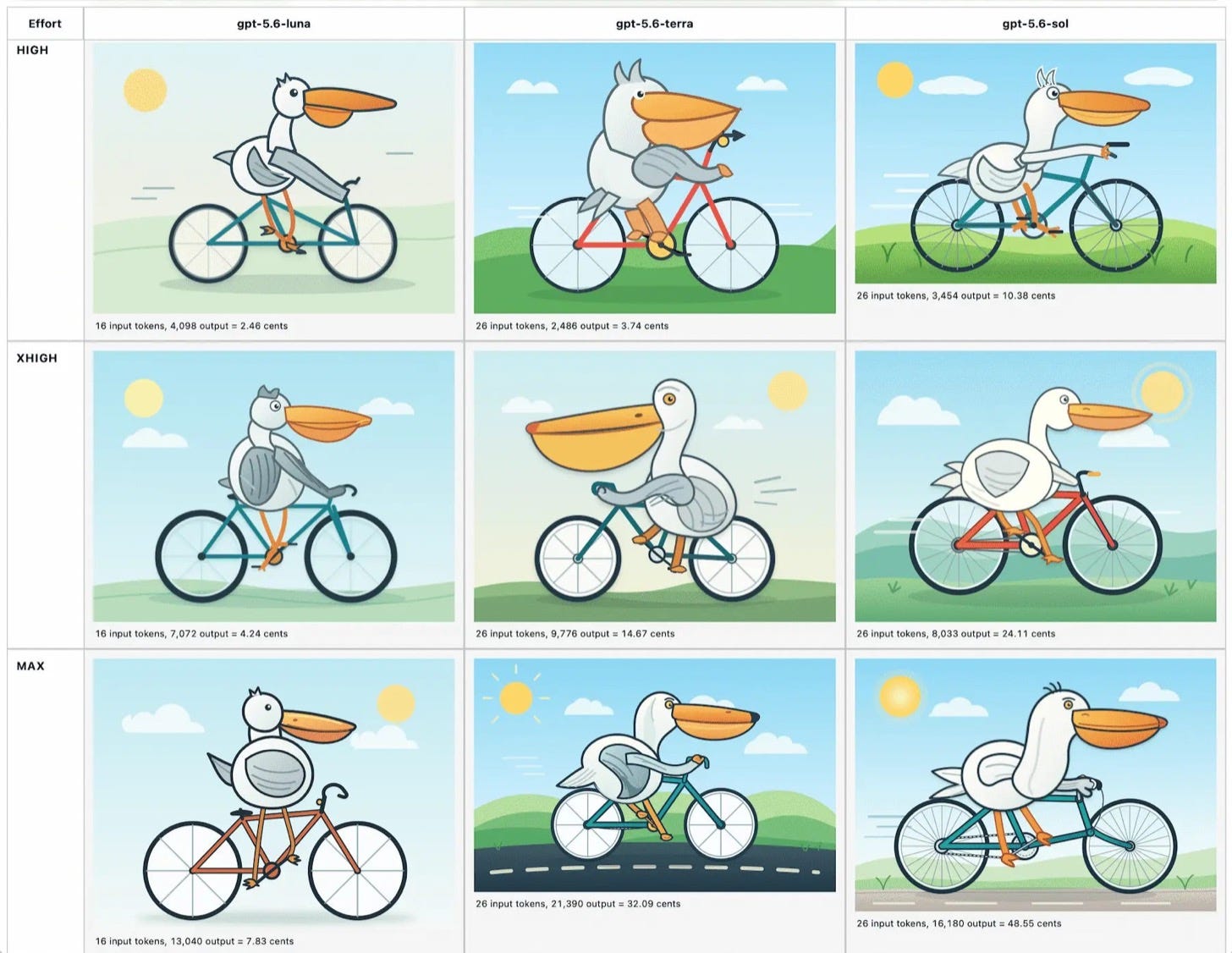
That’s kind of obvious though. The subject of the piece is AI itself.
If we go slightly further out, there are data indices/tools that couldn’t have been built without AI—at least not without extreme expense and lots of labor.
Karpathy’s US Job Market Visualizer is one. It takes 342 occupations covering 143 million jobs across the US economy and classifies them using LLMs. As per his description:
LLM-powered coloring: The source code includes scrapers, parsers, and a pipeline for writing custom LLM prompts to score and color occupations by any criteria. You write a prompt, the LLM scores each occupation, and the treemap colors accordingly. The “Digital AI Exposure” option is one example — it estimates how much current AI (which is primarily digital) will reshape each occupation. But you could write a different prompt for any question — e.g. exposure to humanoid robotics, offshoring risk, climate impact — and re-run the pipeline to get a different coloring.
The Bank for International Settlements also published an interesting paper on using LLMs to build indices of macroeconomic sentiment. Outside of macroeconomics (… which admittedly is one of my fortes, so I know more of these), I’m sure there are plenty of other interesting projects as well.
Can you trust them? Well, as much as you trust any other methodology for economic or scientific data. Everything has tradeoffs. But the fundamental difference here is it’s not a matter of laziness or not taking responsibility. AI or, specifically, LLMs are used, and cited, because the work would otherwise have been impossible through normal automated means and impractical with human labor.
Putting aside LLMs, there is the more mundane convention of citing potentially questionable data when you can’t find anything better and you want the reader/listener to have that in mind. Sometimes, there is no other option and you add a cautionary note because there’s no more work that can be done to make what you’re citing more trustworthy.
None of those apply to, say, a podcast citing a stat from Claude about the Chicago housing market twenty years ago that you can find with a little bit of effort.
Adapting to AI as a Tool and Not as Magic
Many of us probably remember growing up and being taught not to cite Wikipedia. “Anyone can edit it!” Given how often it’s right, it seems a bit silly, but the underlying reason is still one of being able to trust your sources.
AI slop in writing, art, or anything else comes from doing things thoughtlessly. It is possible—and will become more and more common—to use AI to produce high-quality work. Photography used to “not be real art,” versus drawing and painting. Then, digital photography used to “not be real photography,” versus developing physical film in a darkroom. And now, AI-generated art isn’t “real art,” versus what has been tweaked in sliders, filters, and layers in Photoshop, Illustrator, or Procreate.
Tools change and often make “slop” easier to generate. It obviously takes less time to take a terrible photograph (even with film) than to do a drawing. But there’s still a difference between good photography or cinematography and bad. No matter the medium, it takes effort to make something good.
One example? I recently came across an (at the time) small YouTuber who has made a series of “live-action KPop Demon Hunters” (my description, not his—which I assume is to avoid copyright issues). JOEY’s videos are shockingly good and have raised the “are we cooked?” reaction from movie industry people.
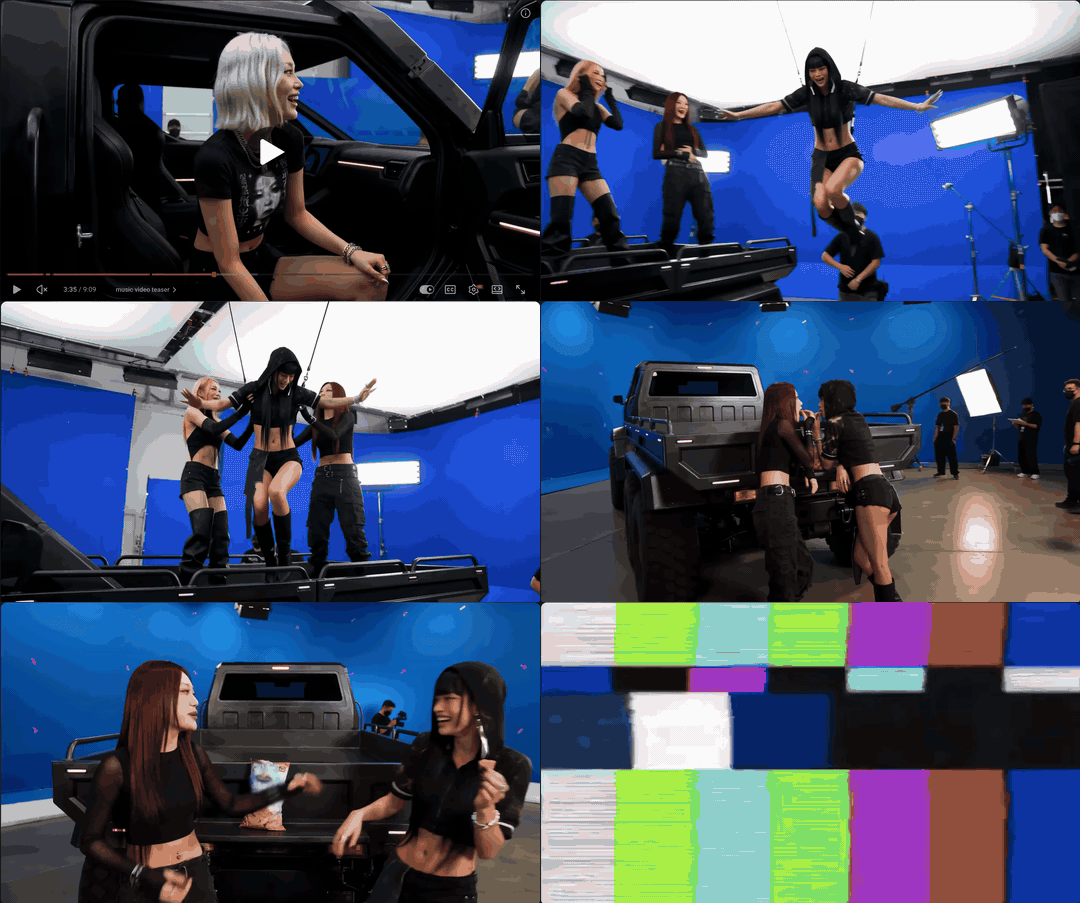
Why is his stuff so good while so many AI videos are… well, AI slop?
One reason is he obviously put a huge amount of work into the Claude skills and pipeline to get consistent characters (which is hard if you’ve ever played around with this), realistic-looking textures/skins and lighting, and relevant mood boards/background stories. He prompts for anamorphic lenses, camera language, color grading… He’s a videographer/cinematographer. He already knows what kind of lighting setups, scenes, and cameras he likes from his real video experience. He even brought in a (human) fashion director to do the costumes, since he doesn’t have that background!
This isn’t just typing something random in and getting an output. As he says:
Disclosure: every good video will still need multiple takes and generations, these skills will not eliminate having to spend hundreds and thousands of credits, but your output generations will be significantly better than trying to have Claude memorize every prompt style.
His prompt for a single scene—which is only 15 seconds—is longer than my article.
This reminds me a lot of Death of an Author by Stephen Marche, which I’ve talked about both in my book and here. It’s an entirely “AI-generated” book in the sense that ChatGPT (with an assist from Sudowrite and Cohere) wrote it. But Marche wrote the plot (because when he tried, ChatGPT couldn’t do a competent job of it) and kept regenerating it until it came out with what he wanted to release. Whether he typed it on a typewriter, wrote it in Microsoft Word, or mashed regenerate on ChatGPT a million times until it did what he wanted, he’s the one with the expertise, vision, and creative control of the output. I think it’s unquestionable he’s the author. What he did—and what JOEY does—is worlds apart from blindly dumping a prompt into AI and passing it along to your audience.
But that does bring up a constant refrain I’ve had: AI works best with experts, whom I refer to as Oracles.
AI multiplies productivity that is already there. Give a coding agent to a superb programmer and you can get 100X the output. Give a coding agent to a terrible programmer and you can also get 100X the output. There’s only one of these two you actually want to 100X.
AI is a productivity tool. If you want to be poetic, it is a lens that magnifies what you already have. It may be easier to do certain things, just as it’s much easier to use Microsoft Word than it is to use a manual typewriter. But if you do the equivalent of blindly mashing on your keyboard or vomiting out a thoughtless stream of consciousness, it’s still terrible either way.
Writing a 2,676-word prompt for a 15-second scene—and a whole pipeline of skills to work with Claude, Higgsfield, and other tools (another 26,275 words)—may be less total human-work for JOEY than a Hollywood production doing it, but it’s certainly not simple either. AI slop isn’t because of AI. AI slop is because of people’s lack of effort in using the tool.
And that’s why citing ChatGPT or Claude or Grok, or whatever else comes along, is bad. You’re doing the work, not your tools. While you can’t reasonably blame your tools if your work comes out poorly, I do think your audience can quite reasonably blame you.
Thanks for reading!
I hope you enjoyed this article. If you’d like to learn more about AI’s past, present, and future in an easy-to-understand way, I’ve published a book titled What You Need to Know About AI.
You can order the book on Amazon, Barnes & Noble, Bookshop, or pick up a copy in-person at a local bookstore.

The comparison to Wikipedia I think is interesting.
The usual objection is that Wikipedia is not a “primary” source and is instead a summary of primary sources by design. This applies to LLMs as well as they are inherently a kind of “summary” of their training data.
One thing a citation is SUPPOSED to provide is a reference which can be checked and followed up by the reader. Wikipedia cite does provide this if you include both the page and date of citation (even if it gets changed later history is preserved/recorded). The LLMs fail this because no one includes the full prompt in the citation or even if they did, LLMs are non deterministic by nature and may not say the same information consistently.
Completely agree. The use of LLMs as a source is laughable. You don’t have to work with them very much to realize that they only partially reliable even for simple tasks. Just had both ChatGPT and Claude fail to identify a brand change on a medical device due to a merger which took place on 2021.